
If your microcredentials don't lead to repeat purchases, clear pathways, or improved employability, the problem isn't the content. It's the strategy.



Which of these stages is your university currently in?
It doesn't matter if you're just getting started or if you've already launched a few courses. The pattern we see at Griky is consistent across almost all institutions:
There are internal discussions, committees, and proposals. But no courses have been launched yet. Time is passing, and the market won't wait.
There are options, but they are few and far between. There are no clear paths forward. We don't know if what was launched is actually working.
We tried it, it didn't work out as expected, and now there are doubts about whether it's worth continuing to pursue.
In all three cases, the problem isn't a lack of content or technology. The problem is a lack of understanding of what a well-designed micro-credential strategy can actually achieve.
The potential you're missing
When designed well, microcredentials don’t compete with your traditional programs. They enhance them. They open doors to segments of students who currently don’t attend your institution: working professionals, people who can’t commit to a full degree program, and companies that need to retrain entire teams.
The mistake is treating them as an add-on to what already exists. The institutions that are winning in this market operate them as a separate strategic unit, with their own approach to design, sales, and measurement.
Why isn't it happening?
It’s not malice or a lack of resources. These are design choices that are repeated without question:
Each of these decisions reduces potential to a fraction of what it could be. And what's worse: they're invisible from the inside because they're mistaken for "the way academia works."
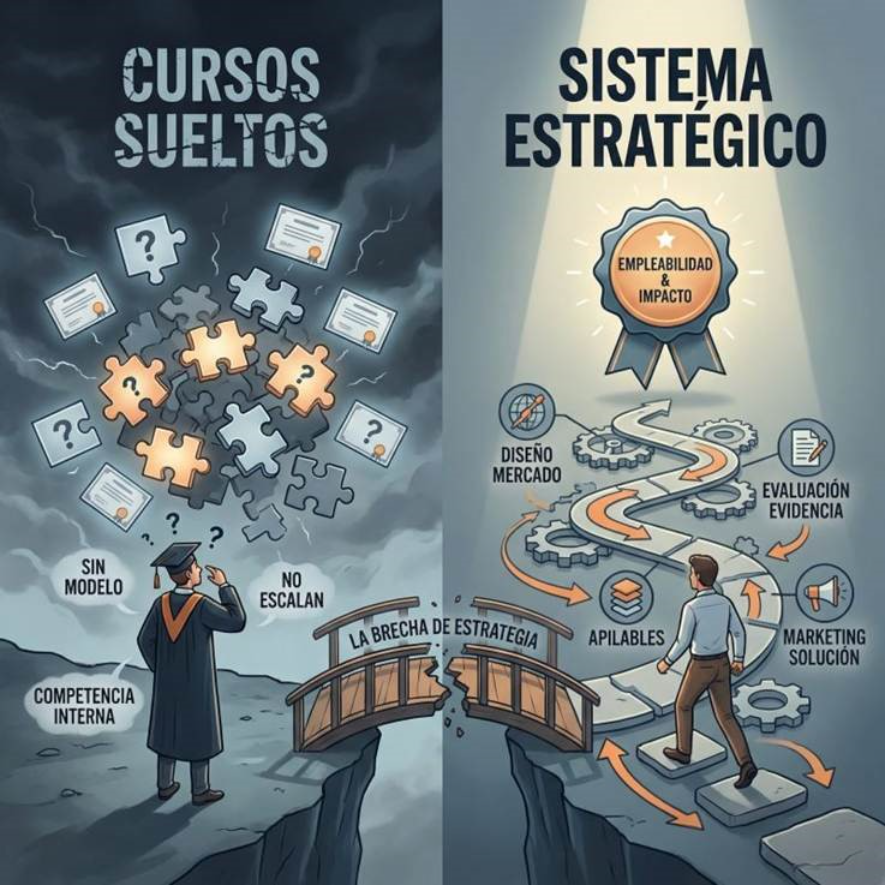
What to do
The first mistake happens before you even create a course: designing it without knowing where it fits into a learning path. Before launching any new micro-credential, ask yourself: "What specific skill does it develop, in which job role is it applicable, and who is willing to pay for it today?"
If there isn't a clear answer for all three parties, it's not a strategic microcredential. It's short-form content that will compete with everything and win against nothing.
The market doesn't buy courses. It buys progress. A single micro-credential doesn't build value. A structured learning path does.
Specific actions
When students know where they're headed from the start, their purchasing decisions change. And so do their repeat purchases.
Just completing a course isn't enough. If, upon completion, there's no tangible evidence of what someone can do, the credential is worthless to an employer—and your student knows it.
Specific actions
Your audience isn't looking for courses. They're looking to advance their careers or solve a specific work-related problem. The language you use determines whether someone clicks or keeps scrolling.
What this does not qualify as: "Certificate in Human Talent Management — 40 hours"
What really makes a difference: "Learn how to lead teams and reduce turnover in your company"
If your only metric is sign-ups, you're making decisions based on incomplete information. Growth is measured differently.
The metrics that matter
Without that data, there’s no way to scale effectively. You’re left with just intuition, and intuition isn’t a strategy.
What's changing
It’s not a gradual change. When the architecture is right, the results are qualitatively different:
But none of that will happen as long as microcredentials remain a marginal experiment. It will happen when they are given the strategic role they deserve.
The universities that will lead the next decade aren't the ones with the most courses. They are the ones that have built a system in which those courses generate real value.
Is your institution building that system, or is it still evaluating whether it's worth the effort?
Building a micro-credential strategy from scratch using traditional methods can take time, money, and expertise that most institutions simply don’t have available today. At Griky, we’ve solved that problem. We offer a complete white-label ecosystem that your university can make its own and start using from day one.
Would you like to see how this would work for your university?
Schedule a demo and we'll show you the entire ecosystem in action, customized with your institution's name and branding.
Discover how to transform your faculty into learning leaders and prepare your university for the age of artificial intelligence.
We continue to design online programs on the assumption that students will manage their own learning. This article offers five concrete steps you can take to start addressing this issue in your next program.
Before launching an online course, review these 9 points. Quality doesn't happen by accident.

Discover how to transform your faculty into learning leaders and prepare your university for the age of artificial intelligence.

We continue to design online programs on the assumption that students will manage their own learning. This article offers five concrete steps you can take to start addressing this issue in your next program.

Before launching an online course, review these 9 points. Quality doesn't happen by accident.

Discover how to launch university courses in weeks (not months) with quality and strategy. Keys to accelerate without losing the pedagogical focus.

Tips to maximize the use of artificial intelligence in universities with pedagogical vision and clear strategy.

Discover which are the key steps to follow to create agile, effective and updated virtual courses.
.png)
Find out how teachers can use artificial intelligence to improve their teaching at universities.


