
We continue to design online programs on the assumption that students will manage their own learning. This article offers five concrete steps you can take to start addressing this issue in your next program.
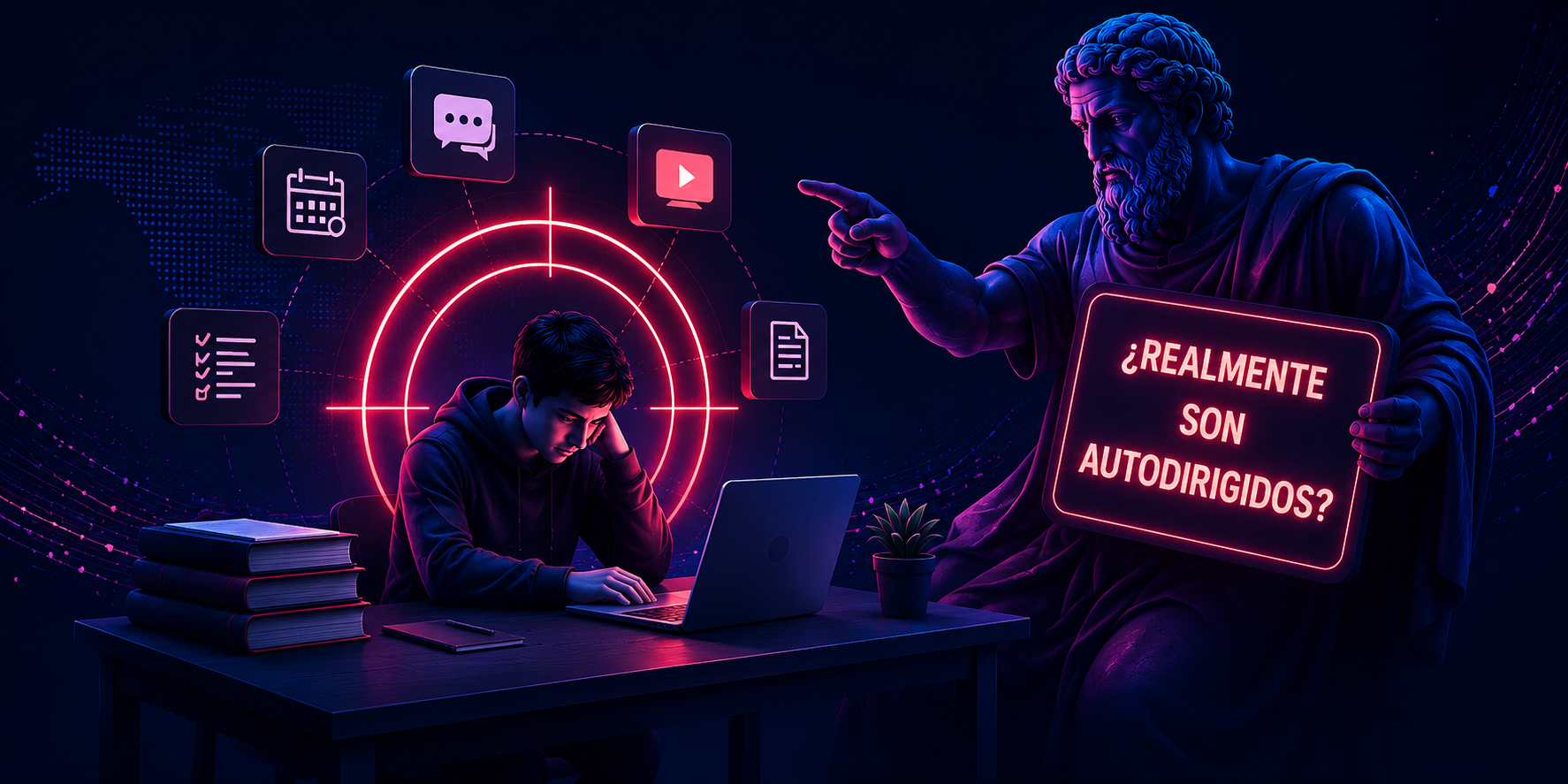


They aren't. And as long as we keep designing as if they were, we pay dearly for it: in dropout rates, in tuition costs, and in unfulfilled educational promises.
There is a phrase that comes up in almost every academic committee: "Today's students are self-directed." We hear it so often that no one questions it anymore. But that phrase lies at the root of one of the most costly problems facing universities today.
The data is unsettling. And it’s worth reading it carefully:
If these numbers resemble those from your programs (or if you don't have the data to know for sure), there's something important to note: the problem is almost never the student.
It's the design.
Self-direction isn't something students are born with. It's a skill. And like any skill, it's developed through structure, guidance, and a plan that builds it up gradually.
The problem is that most virtual programs assume it's already there. And they design accordingly:
And then we're surprised by the dropout rate. Or worse: we blame it on the students.
But when we examine the design of these programs, the reason becomes clear. It’s not that the students don’t want to learn. It’s that the design fails them before they even reach Module Three.
"Designing with the assumption that students will manage their own learning is not pedagogical optimism. It is design negligence. And its consequences are measured in dropout rates."
These aren't just theories. They are documented results from programs that chose to change their approach rather than wait for the students to change:
The difference between a 10% and an 85% completion rate isn't about who is studying. It's about how the curriculum is designed. That's a decision your institution can make.

01 - Design with the assumption that students need structure. Because they do.
Starting from the opposite assumption—that students are self-directed—results in programs that leave them alone in front of a screen, unsure of what to do or where to go next.
02 - Break the content into segments: no more than 7 minutes per video, with a call to action at the end.
Online learning doesn't work the same way as in a classroom. Short modules aren't just easier to digest—they create a sense of steady progress, which is what keeps students engaged.
03 - Design human touchpoints. It doesn't have to be all synchronous—but it does have to be intentional.
Without human support at critical moments, students feel alone in a difficult process. And when that happens, dropping out isn't just a possibility—it's a consequence.
04 - Measure engagement, not just completion rates. Are they participating? Are they applying what they’ve learned?
Enrollment figures tell you how many signed up. Completion rates tell you how many made it to the end. But neither tells you what happens in between—and that’s exactly where retention is won or lost.
05 - Make the path clear. Let students know where they are, what comes next, and why it matters.
Confusion leads to frustration. Frustration leads to dropouts. When a student doesn't understand their path, the likelihood that they'll drop out increases significantly without anyone noticing—until it's too late.
Self-directed learning is the result of good design. Not the starting point.
While we continue to wait for that ideal student—one who is self-motivated, manages their own time, and persists without any structure—real students keep dropping out. And every dropout isn’t just a lost tuition payment. It’s an unfulfilled promise of education.
That's also an institutional decision. And it can be changed.
We create customized online programs for each university, tailored to their educational model, with a team of instructional designers who produce everything: interactive content, assessments, and resources. Designed to ensure that the course not only exists, but actually works.
Improve the design of your programs. Let’s discuss how to reduce dropout rates and improve the outcomes of your online offerings.
Train your teachers with AI. A 3-day challenge to create more effective lessons using artificial intelligence—without getting bogged down in technical details.
Discover how to transform your faculty into learning leaders and prepare your university for the age of artificial intelligence.
If your microcredentials don't lead to repeat purchases, clear pathways, or improved employability, the problem isn't the content. It's the strategy.
Before launching an online course, review these 9 points. Quality doesn't happen by accident.
Discover how to transform your faculty into learning leaders and prepare your university for the age of artificial intelligence.
We continue to design online programs on the assumption that students will manage their own learning. This article offers five concrete steps you can take to start addressing this issue in your next program.
Before launching an online course, review these 9 points. Quality doesn't happen by accident.

Discover how to launch university courses in weeks (not months) with quality and strategy. Keys to accelerate without losing the pedagogical focus.

Tips to maximize the use of artificial intelligence in universities with pedagogical vision and clear strategy.
Discover which are the key steps to follow to create agile, effective and updated virtual courses.
.png)
Find out how teachers can use artificial intelligence to improve their teaching at universities.


