
Discover how to transform your faculty into learning leaders and prepare your university for the age of artificial intelligence.
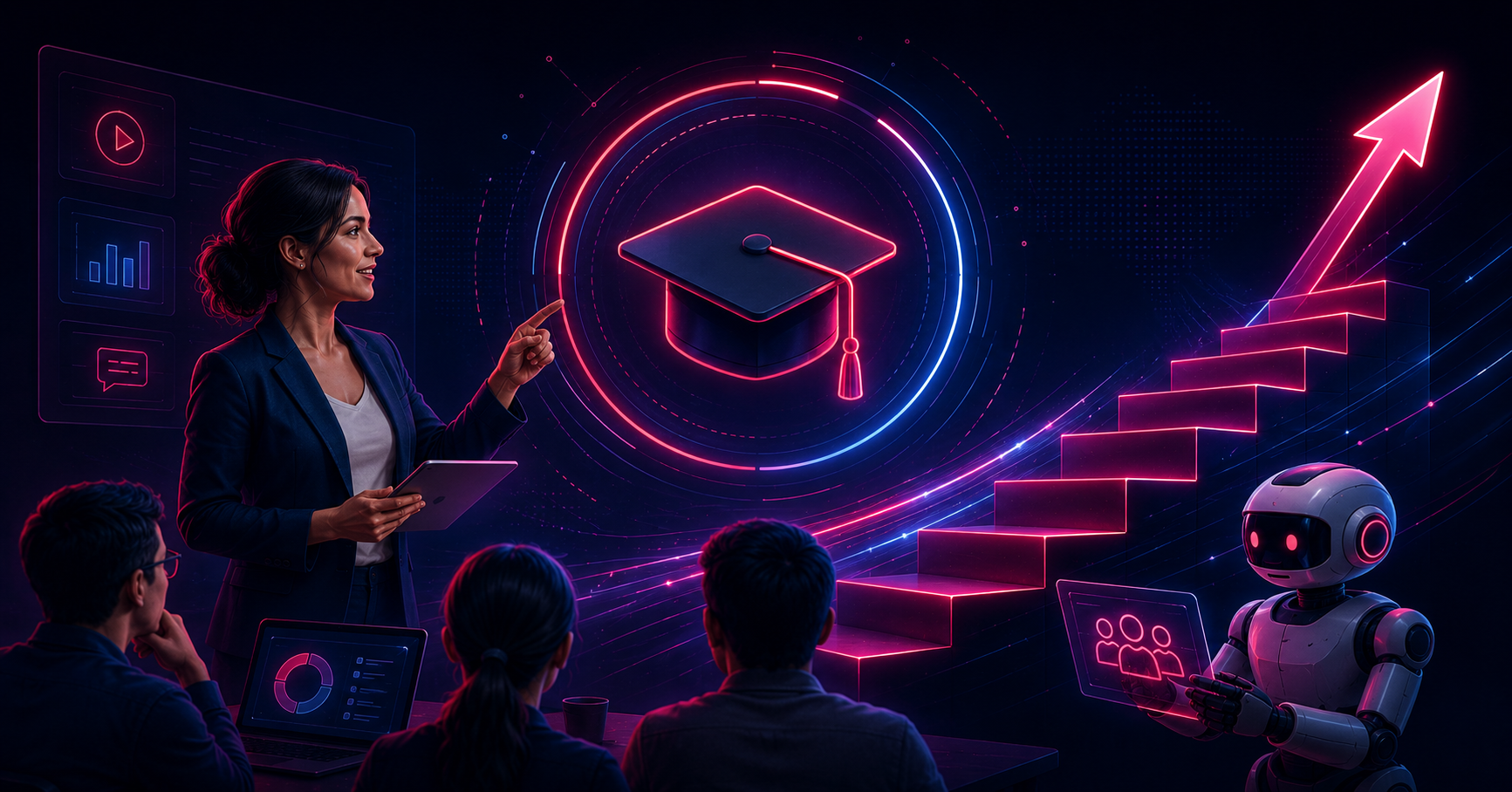


For many years, universities competed for one very clear thing: knowledge.
Whoever had the best teachers, the best libraries, and the best programs had a clear advantage over the rest.
Today, that situation has changed completely.
In just a few minutes, a student can access thousands of courses, videos, simulations, scientific articles, podcasts, and artificial intelligence tools capable of explaining virtually any concept.
Information is no longer scarce. And when something is no longer scarce, it ceases to be the main differentiating factor.
This raises a question that every university should ask itself: What value does a professor bring today that a student cannot obtain on their own?
The answer isn't in explaining a topic better.
It is about helping that student think more effectively, connect ideas, apply knowledge, develop critical thinking skills, and be able to solve complex problems.
That is the true added value of higher education.
And that is why the challenge facing universities is no longer simply to hire outstanding subject-matter experts. It is to develop leaders in learning.
Because knowing a lot about a subject no longer guarantees that a person will be able to create memorable learning experiences.
And that difference will become increasingly important.
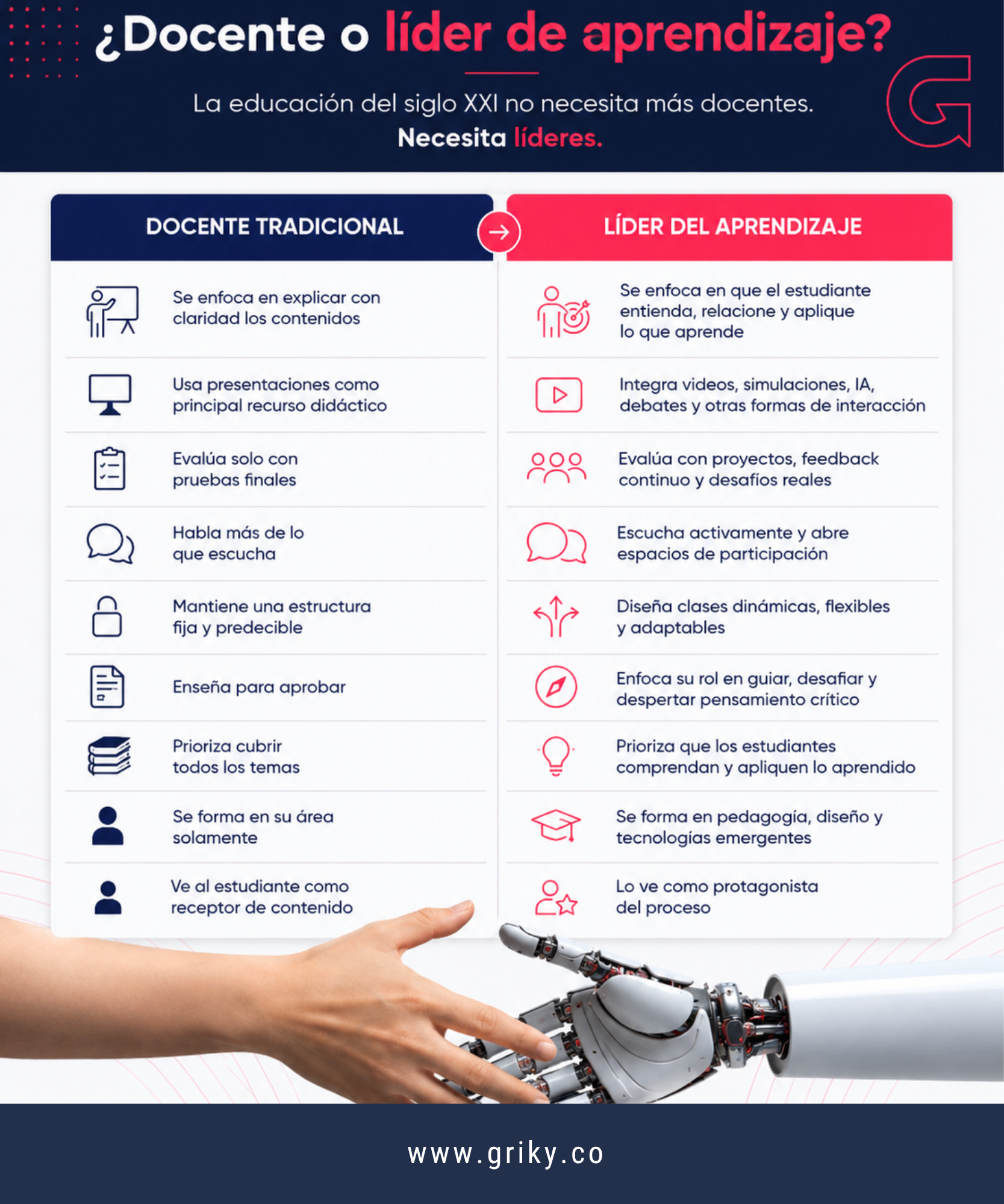
A learning leader understands that teaching is no longer just about conveying information.
Their job is to design experiences that enable students to build knowledge, apply it, and transfer it to real-world contexts.
That completely changes the way we plan a course.
Before preparing a presentation, a learning leader asks themselves questions such as:
When those questions arise, the class stops revolving around the teacher and begins to revolve around learning.
And that small change transforms the entire experience.
The good news is that this transformation does not require waiting for a complete curriculum overhaul.
There are specific measures that any institution can begin to implement.
For years, one of the main indicators of success in a course has been completing the established curriculum.
It is a deeply ingrained practice in higher education: ensuring that all scheduled topics were covered during the semester.
However, in a world where access to information is virtually unlimited, this line of reasoning begins to lose its meaning. Simply explaining all the material does not guarantee that students have understood it, much less that they will be able to apply it in real-life situations.
Universities that are leading the educational transformation have begun to change the question that guides their academic decisions.
Instead of asking , “Have we covered all the topics yet?”, they focus on , “What evidence do we have that our students have developed the skills we expected them to?”
This shift in perspective profoundly changes the way courses are designed, classes are planned, and assessments are conceived.
The goal is no longer to work through a syllabus but rather to ensure that learning actually takes place.
When success is measured by learning outcomes rather than by the amount of content taught, teachers have greater freedom to delve deeper into essential topics, incorporate active learning methods, provide ongoing feedback, and adapt the pace of instruction to their students’ needs.
As a result, learning becomes more meaningful, relevant, and lasting.
Action Item for University Leaders: Review how your institution defines and evaluates teaching quality.
It incorporates indicators that measure the achievement of learning outcomes, the development of competencies, and the application of knowledge, beyond mere compliance with the curriculum.
The discussions that take place in academic committees ultimately shape the priorities of the entire institution; make sure those discussions focus on learning and not just on covering the material.
In recent years, many universities have begun training their faculty in the use of artificial intelligence tools such as ChatGPT, Claude, and Gemini.
It is certainly an important step. However, there is a risk of focusing the conversation on technology and forgetting what truly determines the quality of an educational experience: pedagogy.
Learning to write better prompts can help a teacher work faster, but it doesn't guarantee that their students will learn better.
True transformation occurs when artificial intelligence is combined with a solid grasp of instructional design and learning methodologies.
Skills such as designing active learning experiences, facilitating high-value discussions, providing effective feedback, creating authentic assessments, and setting challenges that connect to the real world remain at the heart of a quality education. AI can enhance all of these capabilities, but it cannot replace the pedagogical judgment needed to decide when, how, and why to use them.
Therefore, the institutions that will have the greatest impact will not be those that teach the most tools, but rather those that develop teachers capable of integrating technology into a learning-centered educational model.
Innovation does not consist of incorporating artificial intelligence into a traditional classroom, but rather of using it to redesign the educational experience from the ground up.
Action Item for University Leaders: Review your teacher-training program and ensure that pedagogical competencies are central to it.
It combines training in artificial intelligence with instructional design programs, active learning, authentic assessment, and innovative methodologies.
Technology is evolving rapidly; a solid pedagogical foundation will enable your teachers to make the most of any tools that emerge in the future.
One of the biggest challenges in higher education today is not conveying information, but capturing and maintaining students' attention in an environment full of distractions.
Various studies have shown that the first few minutes of a session are crucial for sparking interest, activating prior knowledge, and preparing students for learning.
However, it is still common to find classes that begin with long periods of lecture before inviting students to participate.
Learning leaders turn this logic on its head. Instead of starting by explaining, they begin by engaging students. A thought-provoking question, a real-life case study, a recent news story, a professional dilemma, an interactive survey, or a brief team challenge can completely transform the dynamics of a class.
These strategies not only capture students' attention from the start, but also spark curiosity, encourage discussion, and help students connect the material to real-life situations right from the beginning.
When a student actively participates from the very beginning, they move beyond a passive role and become the protagonist of their own learning. The classroom ceases to be a place where they simply receive information and becomes an environment where they analyze, debate, construct, and apply knowledge together with their classmates and teachers.
Call to Action for University Leaders: Encourage each course to incorporate an engagement strategy at the beginning of every session. Train your faculty in active learning methodologies and share examples of best practices across departments.
A small change in the first five minutes can make a significant difference in student engagement, motivation, and the quality of learning throughout the entire class.
For many years, the success of a course was measured by the number of topics it covered during the semester.
However, in a world where information is available anytime, anywhere, that approach has lost its relevance.
The real challenge is no longer to expose students to more content, but to help them understand it, connect it to other knowledge, and use it to solve real-world problems.
The most innovative universities are rethinking this approach. Instead of trying to cover an ever-increasing number of topics, they are identifying which learning outcomes are truly essential and devoting more time to exploring them in depth.
This allows students to analyze case studies, participate in discussions, work on projects, receive feedback, and practice the skills they will need in their professional lives.
In the end, a concept understood in depth has a much greater impact than ten topics covered only superficially.
This change also requires a critical review of the curricula. In many institutions, there is content that is repeated across courses, topics that are no longer relevant, or units that take up time without adding significant value to the graduate profile.
Freeing up that space makes it possible to incorporate learning experiences that are much more relevant and aligned with today's challenges.
Action Step for University Leaders: Review your academic programs with one question in mind: What knowledge and skills will still be truly valuable to our students five years from now?
Eliminate redundancies, update outdated content, and make more room for practice, reflection, and application.
In 21st-century education, the depth of learning has a much greater impact than the number of topics taught.
Artificial intelligence has the potential to profoundly transform a teacher's work—not because it will replace them, but because it can relieve them of a significant portion of their administrative workload.
Today, it can generate a first draft of a questionnaire, suggest activities, create supporting materials, adapt content to different levels, translate resources, develop rubrics, or summarize information in a matter of minutes. Tasks that used to take several hours can now be completed much more quickly.
The true value of this technology lies not in producing more content, but in giving teachers back their scarcest resource: time.
Time to better support their students, provide more personalized feedback, design more meaningful learning experiences, identify challenges early on, and foster conversations that spark critical thinking.
In other words, AI should not be used to do more of the same, but rather to allow teachers to devote more energy to what no technology can replace: inspiring, guiding, and facilitating learning.
Call to Action for University Leaders: Identify the repetitive tasks that currently take up the most of your faculty’s time and implement AI tools to automate them. Every hour saved is an opportunity to invest in greater interaction with students, better instructional design, and a higher-quality educational experience.
Success will not be measured by how much AI the institution uses, but by how that AI enhances your teachers' learning and impact.
Universities expect their students to develop a mindset of lifelong learning in order to adapt to an ever-changing world. However, that same principle must also apply to the professional development of those who teach.
In a context where artificial intelligence, teaching methodologies, and the needs of the labor market are evolving at a rapid pace, lifelong learning is no longer an option but has become an essential skill for 21st-century teachers.
The institutions that will make a difference are those that make teacher development a daily practice, rather than an occasional training session.
This involves creating spaces where teachers can observe their colleagues’ classes, share experiences, experiment with new teaching strategies, analyze evidence on how students learn best, and reflect together on their teaching practices.
When peer learning among teachers becomes part of the institutional culture, innovation is no longer dependent on a few enthusiasts and begins to spread naturally throughout the organization.
Furthermore, this culture sends a very powerful message to students: that learning does not end when they earn a degree, but rather is a lifelong commitment. Teachers who continue to learn serve as role models for exactly the kind of professionals that universities seek to develop.
Call to Action for University Leaders: Make faculty development a strategic priority. Create communities of practice, promote regular opportunities to share best practices, encourage pedagogical experimentation, and recognize those who innovate in the classroom.
A university that is constantly learning will be much better prepared to meet the challenges of the future than one that only updates its curriculum every few years
Artificial intelligence will continue to evolve at a rapid pace. Each year, it will be able to generate better content, automate more processes, personalize learning experiences with greater precision, and take on tasks that still require human intervention today.
This development will transform the way we design courses, evaluate students, and manage much of our academic work.
However, the more technology advances, the more evident the value of what only people can contribute will become. No artificial intelligence can lead by example, build trust in times of uncertainty, recognize the potential of a student who doesn’t yet believe in themselves, or ask the question that forever changes the way we understand a problem.
Nor can it foster a culture of learning, spark curiosity, support personal growth, or help develop the ethical judgment and critical thinking skills demanded by an increasingly complex world.
That is why the challenge for universities is not to compete with artificial intelligence, but to leverage it to strengthen what makes them truly irreplaceable.
The institutions that will lead the next decade will not necessarily be those that adopt the most technological tools, but rather those that succeed in empowering their faculty to become true leaders in learning—people capable of designing memorable experiences, connecting knowledge to real-world challenges, and preparing graduates to learn, adapt, and innovate throughout their lives.
In an environment where access to information no longer represents a competitive advantage, true differentiation will lie in the quality of the learning experiences a university is able to offer.
The question for university leaders is no longer how to incorporate more technology into their classrooms, but how to use that technology to amplify the impact of their faculty and accelerate the educational transformation of their institutions.
We continue to design online programs on the assumption that students will manage their own learning. This article offers five concrete steps you can take to start addressing this issue in your next program.
If your microcredentials don't lead to repeat purchases, clear pathways, or improved employability, the problem isn't the content. It's the strategy.
Before launching an online course, review these 9 points. Quality doesn't happen by accident.
Discover how to transform your faculty into learning leaders and prepare your university for the age of artificial intelligence.
We continue to design online programs on the assumption that students will manage their own learning. This article offers five concrete steps you can take to start addressing this issue in your next program.
Before launching an online course, review these 9 points. Quality doesn't happen by accident.

Discover how to launch university courses in weeks (not months) with quality and strategy. Keys to accelerate without losing the pedagogical focus.

Tips to maximize the use of artificial intelligence in universities with pedagogical vision and clear strategy.
Discover which are the key steps to follow to create agile, effective and updated virtual courses.
.png)
Find out how teachers can use artificial intelligence to improve their teaching at universities.


